What Are the Top 5 NASA Grade Pickleball Paddles: Expert Picks, Features, and Buying Guide
You want the best NASA-grade pickleball paddles for power, spin, and control. The top five NASA-grade paddles combine lightweight carbon fiber, advanced core tech, and pro-level balance to give you elite performance on the court.
This guide shows which paddles stand out in 2025 and why each one might fit your game. You will get clear picks and quick reasons so you can choose the paddle that boosts your serve, dink, or drive.
Key Takeaways
- Elite NASA-grade paddles blend carbon and advanced cores for better feel and power.
- The top five models differ mainly in balance, spin potential, and control.
- Choose a paddle that matches your play style and comfort for the best results.
Overview of NASA Grade Pickleball Paddles
You will learn what makes a paddle “NASA grade” and how that label relates to USAPA approval and tournament rules. Expect clear criteria about materials, construction, and official play limits.
What Defines a NASA Grade Paddle
We continue to see paddle technology evolve. A “NASA grade” paddle typically uses aerospace materials like carbon fiber, titanium, or advanced composites. These materials make paddles stiff, light, and very durable. You should expect a core of polymer or Nomex wrapped in carbon fiber face layers.
Key specs you should check:
- Weight: 7.0–8.5 oz for control or power balance.
- Thickness: 12–16 mm cores for consistent pop and a solid feel.
- Surface texture: Smooth or mildly textured carbon for spin without excess grit.
- Edge and handle: Reinforced edges and ergonomic handles with vibration dampening.
Manufacturers market “NASA grade” to mean high-performance materials and tight tolerances. It does not mean actual NASA certification. Focus on measurable traits—weight, balance, core type, and face material—when judging performance.
USAPA and Tournament Approval Standards
USAPA governs tournament legality with clear rules on size, shape, and surface. Your paddle must be single-faced, rectangular with rounded corners, and no longer than 17 inches, including handle. Surface roughness and material types are allowed, but surfaces that alter spin beyond normal friction can be disallowed.
Key USAPA checks:
- Length/width limit: 24 inches total perimeter and max 17 inches in length.
- No attachments: You cannot add devices that change play, like springs or electronic aids.
- Marking and testing: USAPA may test surface friction and bounce if a paddle is questioned.
If you plan to play tournaments, buy paddles labeled USAPA-approved or check the approved list. Keep the original specs and proof of purchase if you need to appeal a ruling.
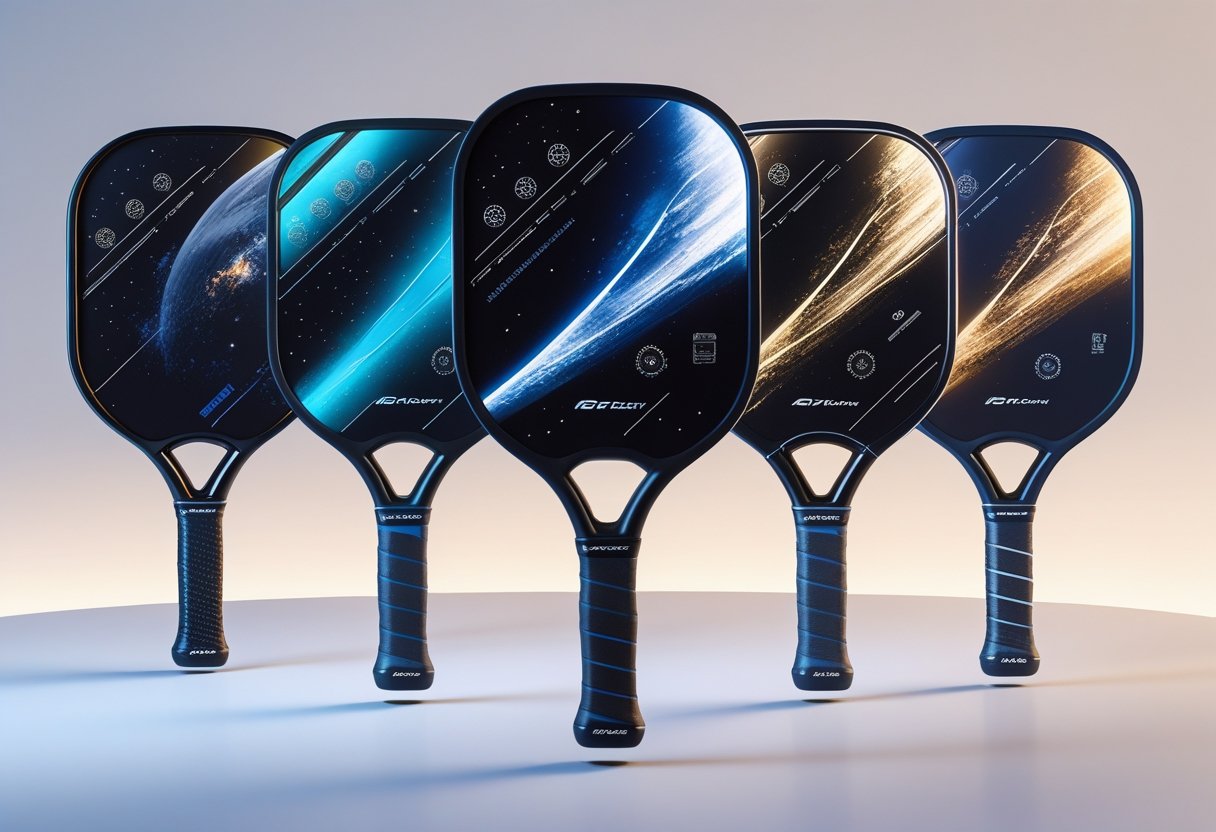
The Top 5 NASA Grade Pickleball Paddles in 2025
These paddles prioritize a mix of power, control, spin, and comfort. Each model uses advanced core or face tech that affects feel, speed, and shot consistency.
Honolulu J2NF: Performance and Features

The Honolulu J2NF targets players who want power without losing touch. It pairs a stiff composite face with a thin 12mm core to boost ball speed on drives and smashes. You’ll notice a louder pop and longer carry on deep drives, which helps when you attack from the baseline. A good paddle for players that are coming from tennis!
The shape favors a medium-weight swing (about 7.8–8.2 oz), giving you balance between maneuverability and momentum. The grip is cushioned and slightly tapered to help with wrist control for rapid volleys. If you want a paddle that leans power-first but still lets you block and redirect at the net, the Honolulu J2NF ranks high among the best pickleball paddles for aggressive play.
Bread & Butter Loco: All-Court Versatility

Bread & Butter Loco aims to be an all-court paddle for players who switch between dinks, drives, and third-shot drops. It uses a textured composite face for reliable spin and a 14mm poly core to soften impact and extend dwell time. That dwell time gives you more control on touch shots and better spin on topspin drives.
You’ll find the weight sits around 7.6–8.0 oz, making it easy to recover at the net yet stable on power shots. The paddle’s elongated sweet spot helps you place deep serves and angled returns. If you need one paddle that adapts to different court positions, the Bread & Butter Loco stands out as an all-court paddle choice.
Six Zero Black Opal: Power Paddle Insights

Six Zero Black Opal focuses on raw power and shot penetration. It combines a stiff carbon face with a dense 10–12mm core to reduce energy loss on impact. You’ll get firm feedback and fast ball exit speed, which helps finish points quickly when you swing hard.
Grip thickness is moderate, and edge protection is robust for aggressive play. This paddle can feel less forgiving on soft dinks, so you must refine touch shots to avoid mis-hits. For players prioritizing pace and aggressive baseline play, the Six Zero Black Opal ranks among the best pickleball paddles for power-driven styles.
Gearbox GX2 Power Hybrid 16mm: Control and Core Tech

Gearbox GX2 Power Hybrid 16mm centers on control through a thicker, 16mm aluminum honeycomb core. The extra core height increases dwell time and dampens vibration so you can place soft third-shot drops with confidence. The hybrid face balances stiffness and flex to produce predictable responses across shot types.
You’ll notice a heavier feel (around 8.2–8.6 oz) that stabilizes swings and helps follow-through on drives. The firm yet forgiving touch makes the GX2 a favorite for players who want a control-first paddle that still generates usable power. If precision and shot timing matter most, the Gearbox GX2 Power Hybrid 16mm gives you core tech that supports both.
CRBN TruFoam Genesis 4: Spin and Soft Touch

CRBN TruFoam Genesis 4 emphasizes spin and a soft hand feel using a proprietary TruFoam core and a micro-textured carbon face. The foam core increases dwell time and reduces shock, letting you impart more spin while protecting your shoulder and elbow. You’ll get rounded, controllable shots on dinks and heavy, biting spin on return serves.
Weight targets 7.4–7.9 oz, which helps quick wrist snap for spin-heavy strokes. The paddle shape blends control and reach, so you can defend at the baseline and attack at the net. For players who want spin plus a forgiving feel, the CRBN TruFoam Genesis 4 ranks among the best pickleball paddle options this year.
Key Technologies and Materials in Elite Paddles
Top paddles use advanced cores, carbon surfaces, and precise shape and handle choices to balance power, control, and feel. You’ll find specific materials like polymer cores and T700 carbon fiber faces, plus design tweaks that move the sweet spot and change swing weight.
Core Innovations: Foam and Polymer
High-end paddles often use a polymer core or advanced foam to control vibration and energy return. Polymer cores come in blends that trade stiffness for feel; firmer polymers give more pop, while softer polymers dampen shock for better control. Closed-cell polyurethanes are common because they resist water and maintain consistent performance over time.
Foam cores like polypropylene or EVA are lighter and can lower swing weight. Manufacturers tune core thickness and density to shift the sweet spot and adjust dwell time — a thicker core often increases comfort but can reduce crispness. Some designs add internal ribbing or chambers to direct impact forces and reduce dead spots.
You should check core specs (material, thickness in mm, and density) because they directly affect power, touch, and arm comfort. If you have arm issues, choose a softer polymer or a thicker foam. If you want aggressive drives, pick a denser polymer or a thinner core.
Advancements in Carbon Fiber Surfaces
Carbon fiber faces use layers of raw carbon fiber or woven sheets bonded to the core for stiffness and responsiveness. The industry often uses T700 carbon fiber because it balances tensile strength and cost. Pure carbon fiber faces give sharp feedback and high repulsion, which boosts power without much added weight.
Manufacturers vary weave patterns and resin systems to tune surface stiffness and texture. A smoother carbon fiber surface helps spin and fast shots, while textured finishes improve ball grip for spin control. Multi-layer carbon constructions can combine a thin outer raw carbon layer with inner composite layers to reduce brittleness and expand the sweet spot.
You should compare face material listings like “carbon fiber face” or “T700 surface” and note ply count and resin type. These details predict stiffness, durability, and how large the effective sweet spot will be during volleys and drives.
Comparison of Paddle Surface Materials
| Material | Key Characteristics | Feel & Playstyle | Common Use |
| Graphite | Thin, stiff, and lightweight (typically less than 1mm thick). | Control & Finesse: Offers a very “crisp” feel. Excellent for dinks and drops but requires you to provide your own power. | Advanced players or “control specialists” who want extreme precision at the kitchen. |
| Composite (Fiberglass) | Flexible with a “trampoline” effect; usually heavier and grittier. | Power & Spin: The flexibility creates more “pop.” The natural texture is great for gripping the ball to create heavy topspin. | Beginners needing help with power, or aggressive “bangers” who play a fast, hard-hitting game. |
| Carbon Fiber | Highly durable, rigid, and energy-absorbent. Often seen as “Raw Carbon.” | Balance & Texture: The “Goldilocks” material. It provides the most spin and the largest sweet spot while dampening vibrations. | Professional/Elite play. It is currently the industry standard for high-end, all-around performance paddles. |
Handle, Shape, and Sweet Spot Engineering
Handle length, paddle length, and paddle shape change leverage, reach, and balance. Longer handles give two-handed backhands and more reach, but add swing torque. Standard handle lengths range from 4 to 5.5 inches; choose based on grip size and play style.
Paddle shape (widebody vs. elongated) shifts the sweet spot. Widebody paddles place the sweet spot lower and offer more hitting surface for dinks and blocks. Elongated shapes move the sweet spot toward the tip and increase reach and power for drives.
Engineers also adjust weight distribution and edge geometry to control moment of inertia. A head-heavy paddle raises power but can tire your wrist. A balanced or handle-biased paddle improves control. Look for specs that list paddle length, grip circumference, and swing weight so you can match the sweet spot placement to your game.
Comparing Power, Spin, and Control Across Top Paddles
You will learn how paddle design changes power, spin, and control so you can pick a paddle that matches your game. Focus on weight, balance, face texture, and core stiffness when comparing models.
Power Paddle vs. Control Paddle Dynamics
Power paddles give you harder drives with less swing effort. They use firmer cores (often polymer or Nomex-like cores) and thicker faces. Expect higher ball speed and deeper shots, but you will lose some soft feel on volleys and dinks.
Control paddles use softer cores and thinner faces to absorb energy. This lets you place shots more precisely and slow the ball on the kitchen line. You trade raw speed for better touch and reduced pop on mishits.
If you want both, look for mid-flex cores and elongated sweet spots. Many top “NASA-grade” style paddles aim for a balance: enough core stiffness for power while keeping edge-to-edge control. Check spec sheets for core density and face stiffness numbers.
Spin Potential and Surface Texture
Spin depends mainly on face texture and your swing RPM. Rougher faces and micro-textures increase friction and let you create higher RPM on serves and third-shot drops.
Look for paddles that list “RPM Friction Pro” or similar surface tech. Those faces increase grip on the ball and boost topspin and slice without needing extreme wrist action. Smooth graphite faces give less spin but more predictable pop.
Your technique still controls spin more than any label. A textured face adds 200–800 RPM on average for common players. Test spin with a controlled flick and compare how the ball reacts on slice or heavy topspin shots.
Optimal Paddle Weight and Balance
Paddle weight changes power, control, and arm fatigue. Heavier paddles (9.5–10.5 oz) increase momentum and power but tire your wrist faster. Lighter paddles (7.8–8.5 oz) improve reaction and touch, helping control at the net.
Balance matters too. Head-heavy paddles add swing power and push your shots deeper. Handle-heavy or evenly balanced paddles favor wrist control and quick blocks. For mixed play, choose 8.2–9.0 oz with neutral balance.
Match weight and balance to your body and style. If you rely on spin, a slightly lighter paddle helps you generate higher RPM. If you hit flat power shots, a heavier, head-light paddle boosts drive without sacrificing control.
How to Choose the Best NASA Grade Pickleball Paddle for Your Game
Focus on weight, grip size, paddle shape, and surface material. Match those to your strengths: control, power, quick hands, or reach.
Factors Influencing Paddle Selection
Weight affects swing speed and fatigue. Lighter paddles (6.8–7.3 oz) let you react faster and volley better. Heavier paddles (7.4–8.4 oz) deliver more power on drives and serves but tire your arm sooner.
Grip size changes control and wrist action. Small grips (4 to 4 1/8 in) let you use wristy shots and quick transitions. Larger grips (4 1/4 in and up) stabilize two-handed backhands and reduce torque on your elbow.
Paddle face material and core determine feel and spin. Carbon fiber faces give crisp pop and spin, while fiberglass feels softer. Polymer cores are quieter and forgiving; Nomex cores are firmer and give more power.
Shape matters: wide-body paddles offer a larger sweet spot for consistent returns. Elongated paddles increase reach and power but narrow the sweet spot, demanding better precision. Hybrid paddle designs aim to balance these trade-offs.
Matching Paddle Features to Play Style
If you play at the net and use quick dinks, pick a lightweight, control-oriented paddle with a small grip and polymer core. Look for the best pickleball paddles labeled “control” or “touch” and consider a hybrid paddle for balanced feel.
If you hit hard from the baseline, choose a heavier or elongated paddle with a stiffer core and carbon fiber face for extra pop. That gives more drive and reach but requires accurate placement.
For all-around play, choose a midweight paddle (7.3–7.6 oz) with a medium grip (4 1/8–4 1/4 in) and a hybrid or wide-body shape. This setup helps you switch between power and touch during rallies.
If elbow or shoulder issues matter, prioritize lighter paddles, larger grips, and softer-core materials to reduce vibration and strain.
Honorable Mentions and Emerging Paddles
These paddles offer solid tech, distinct play styles, and smart value. They don’t make the top five list, but can fit specific players who want control, spin, or a unique feel.
Selkirk LABS Project Boomstik
The Project Boomstik blends power and control with a shorter sweet spot than Selkirk’s midface models. You’ll notice a firm response from the thicker polymer core and carbon face that helps drive deep, flat shots without losing stability on blocks.
Weight options run from 7.6–8.4 ounces, so you can choose faster maneuvering or more drive. The handle shape follows Selkirk’s standard grip, which fits most players well and supports consistent wrist placement for volleys and quick resets.
Spin comes from a slightly textured carbon surface rather than aggressive roughing. If you prefer controlled power and predictable returns at the kitchen line, this paddle balances those needs without extreme feel or recoil.
JOOLA Perseus Pro IV
The Perseus Pro IV targets players who want a crisp, controlled hit with added touch. You’ll get a medium-thick core paired with a fibreglass-carbon hybrid face. That combo softens dead spots and improves feel on dinks and third-shot drops.
Balance sits toward the head, giving extra pop on drives while keeping volleys manageable. JOOLA’s edge guard reduces sting on mishits, and the elongated shape extends reach for stretched returns.
If you value court feel and placement over raw power, this paddle gives you consistent control and a smooth transition from soft play to aggressive drives.
Six Zero Double Black Diamond Control
Six Zero’s Double Black Diamond Control name signals a player-first design for precision. You’ll feel a low-profile, dense core that tightens response on soft shots and short-angle control. The face texture is finely sanded to add spin without sacrificing touch.
It’s lighter than many control paddles, around 7.4–7.8 ounces, which helps you maintain fast wrists for flicks and reset shots. The narrower body improves directional placement and reduces accidental volleys.
Choose this paddle if your game relies on placement, spin on serve and return, and tight net play rather than raw pace.
Other Notable Models: Fusion, Rocket, Luzz
Fusion, Rocket, and Luzz are smaller brands or lines that deliver specific benefits for niche players. Fusion models often mix carbon with polymer cores to smooth feel and cut vibration. You’ll see that in softer dinks and steadier put-aways.
Rocket paddles prioritize lightweight maneuverability and aggressive head-heavy options for power. If you chase quick reactions and explosive drives, Rocket offers models that favor speed. Luzz focuses on value with balanced profiles and durable faces. Their builds give consistent performance at lower price points.
Each of these can match specific needs: Fusion for feel, Rocket for quick power, and Luzz for budget-friendly all-around play.
Frequently Asked Questions
You will find clear answers about paddle choice, feel, weight, and tech. The Q&A lists specific models, materials, and what to expect from performance.
Which pickleball paddles are preferred by professional players?
Pros often use paddles from Selkirk, Paddletek, Engage, JOOLA, and Onix.
They pick models like Selkirk Vanguard, Paddletek Tempest, Engage Pursuit, JOOLA Ben Johns, and Onix Evoke for control, power, or spin.
Pros choose paddle specs to match their role.
Baseline players favor control and a larger sweet spot. Serve-and-volley players prefer lighter, quick-handling paddles.
What are the distinguishing features of high-quality pickleball paddles?
High-quality paddles use carbon fiber or fiberglass faces and polymer or Nomex cores.
They have consistent weight, balanced sweet spots, and durable edge guards.
Good paddles show tight seam work, secure grip wraps, and low vibration on impact.
You can test quality by checking pop sound, edge durability, and grip comfort.
How do advanced player paddle preferences differ from beginners?
Advanced players want specific weight, balance, and surface texture for spin or power.
They often choose heavier paddles (7.5–8.4 oz) for drive power or midweight (7.2–7.8 oz) for control.
Beginners do better with lighter, forgiving paddles (about 7.0–7.4 oz) and larger sweet spots.
Beginners should prioritize comfort and consistency over specialized features.
What are the best pickleball paddles for spin in 2025?
Top spin paddles in 2025 include Selkirk Vanguard Hybrid, Engage Pursuit MX, and JOOLA Ben Johns Pro.
These use textured carbon faces or proprietary rough coatings to bite the ball more.
Look for paddles labeled “textured carbon” or “spin-enhanced” and weights you can control.
Thinner cores and firm faces also help generate more spin.
Can purchasing a more expensive pickleball paddle improve your game?
A pricier paddle can help if it matches your play style and you know how to use it.
Upgrades matter most when they give you better control, a consistent response, or less vibration.
Spending more won’t fix poor technique. Invest in lessons and practice first, then upgrade equipment to refine performance.
What are the latest technological advancements in pickleball paddles?
Recent advances include textured carbon faces, multi-layer composite cores, and vibration-dampening grips. Manufacturers now tune core firmness and face roughness to balance spin, control, and power.
Some paddles use aerospace-grade carbon blends and precision weight distribution. These changes aim to improve consistency and reduce hand fatigue.